

Safe Sleep Guidelines for Babies: What Every Parent Should Know.
Bringing home a new baby is exciting—but it also comes with many questions, especially about sleep. Creating a safe sleep environment is one of the most important ways to protect your baby during the first year of life.
The American Academy of Pediatrics (AAP) updated its safe sleep recommendations in 2022 to help reduce the risk of Sudden Infant Death Syndrome (SIDS) and other sleep-related infant deaths. Below is a parent-friendly guide to the most important recommendations.
1. Always Place Your Baby on Their Back to Sleep
The safest sleep position for every baby is flat on their back, for every nap and every night.
This recommendation applies even if your baby:
- Was born prematurely
- Has gastroesophageal reflux (GERD)
- Spits up frequently
Many parents worry that babies sleeping on their backs may choke if they spit up. However, research shows this is not true. When babies sleep on their backs, their airway anatomy actually helps prevent milk or stomach contents from entering the lungs.
Should Babies Sleep on Their Side?
No. The AAP does not recommend side sleeping because babies can easily roll onto their stomachs.
What If My Baby Rolls Over?
Once your baby can roll from back to tummy and tummy to back on their own, you don’t need to reposition them during the night. However, you should always place them on their back at the beginning of every sleep until they reach their first birthday.
2. Use a Firm, Flat Sleep Surface
Your baby should sleep on a firm, flat mattress that fits snugly inside a safety-approved crib, bassinet, or play yard.
Avoid:
- Inclined sleepers
- Soft mattresses
- Adult beds
- Recliners
- Sofas
- Car seats for routine sleep
A car seat is designed for travel—not regular sleep. If your baby falls asleep in a car seat, move them to a safe sleep surface as soon as possible once you’ve reached your destination.
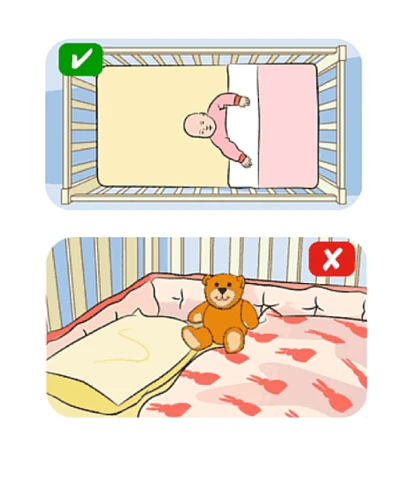
3. Keep the Crib Empty
One of the leading causes of accidental suffocation is having soft objects inside the crib.
Your baby’s crib should contain only:
- A firm mattress
- A fitted crib sheet
Do not place:
- Pillows
- Blankets
- Loose sheets
- Stuffed animals
- Sleep positioners
- Nursing pillows
- Crib bumpers
Instead of loose blankets, dress your baby in:
- Footed pajamas
- Wearable blankets or sleep sacks
These keep babies warm while reducing suffocation risks.
4. Share a Room—Not a Bed
The AAP recommends that babies sleep in the same room as their parents for at least the first 6 months, and ideally for the first year.
Room-sharing can reduce the risk of SIDS by up to 50% while making nighttime feedings easier.
However, bed-sharing is not recommended because it significantly increases the risk of:
- Suffocation
- Entrapment
- Accidental overlay
- Sleep-related infant death
If you bring your baby into bed for feeding or comforting, return them to their own sleep space before you fall asleep.
5. Never Sleep with Your Baby on a Sofa or Recliner
Sofas, armchairs, and recliners are among the most dangerous places for infants to sleep.
If you’re feeling sleepy while feeding your baby:
- Feed in your bed rather than on a couch.
- Remove pillows, heavy blankets, and other soft bedding.
- Return your baby to their crib or bassinet as soon as you’re awake.
6. Breastfeeding Helps Reduce SIDS Risk
Breastfeeding offers many health benefits—including lowering the risk of SIDS.
Whether you exclusively breastfeed or combine breast milk with formula, breastfeeding is encouraged whenever possible.
7. Avoid Overheating
Babies don’t need to be bundled in multiple layers.
A simple rule:
Dress your baby in one more layer than you’re comfortable wearing.
Watch for signs of overheating:
- Sweating
- Damp hair
- Warm chest
- Flushed skin
Keep hats and hoods off indoors during sleep.
8. Keep Your Home Smoke-Free
Exposure to cigarette smoke before or after birth significantly increases the risk of SIDS.
For the healthiest environment:
- Don’t smoke during pregnancy.
- Keep your home smoke-free.
- Keep your car smoke-free.
- Ask visitors not to smoke around your baby.
9. Avoid Alcohol and Drugs During Pregnancy and After Birth
Alcohol, marijuana, opioids, and other drugs can increase sleep-related risks by affecting a caregiver’s ability to safely care for a baby—especially during nighttime feedings.
10. Stay Up to Date on Well-Baby Visits and Vaccinations
Routine pediatric appointments allow your baby’s doctor to monitor growth, development, and sleep safety.
Keeping your baby vaccinated according to the recommended immunization schedule has also been associated with a lower risk of SIDS.
11. Don’t Rely on Products That Claim to Prevent SIDS
Many products marketed to parents promise to reduce the risk of SIDS.
Currently, no commercial sleep product has been proven to prevent SIDS, including:
- Sleep positioners
- Wedges
- Anti-roll devices
- Specialized mattresses
- Cardiorespiratory home monitors for healthy babies
Always follow evidence-based safe sleep practices instead.
12. Give Your Baby Daily Tummy Time
Tummy time is essential for healthy development—but only while your baby is awake and supervised.
Benefits include:
- Strengthening neck and shoulder muscles
- Preventing flat spots on the head
- Supporting motor development
Start with just a few minutes several times a day and gradually increase as your baby grows.
13. Swaddling Safety
Swaddling may help calm some newborns, but it does not reduce the risk of SIDS.
If you choose to swaddle:
- Always place your baby on their back.
- Stop swaddling as soon as your baby shows signs of rolling over (often around 2–3 months).
- Ensure the swaddle isn’t too tight around the hips.
Quick Safe Sleep Checklist
✔ Always place baby on their back
✔ Use a firm, flat crib mattress
✔ Keep the crib empty
✔ Share a room, not a bed
✔ Breastfeed if possible
✔ Avoid overheating
✔ Keep your home smoke-free
✔ Never let baby sleep on sofas or recliners
✔ Practice supervised tummy time every day
✔ Follow your pediatrician’s guidance and attend regular checkups
Final Thoughts
Following the American Academy of Pediatrics’ safe sleep recommendations is one of the most effective ways to reduce the risk of Sudden Infant Death Syndrome (SIDS) and other sleep-related injuries during your baby’s first year.
While every family’s routine is different, simple habits—like putting your baby to sleep on their back, using a firm crib mattress, and keeping the sleep area free of soft objects—can make a life-saving difference.
Disclaimer: This article is for educational purposes only and should not replace medical advice. Always consult your child’s pediatrician if you have questions about your baby’s sleep or health.
REFERENCE.
Moon RY, Carlin RF, Hand I, THE TASK FORCE ON SUDDEN INFANT DEATH
SYNDROME AND THE COMMITTEE ON FETUS AND NEWBORN. Sleep-Related
Infant Deaths: Updated 2022 Recommendations for Reducing Infant Deaths in the Sleep
Environment. Pediatrics. 2022;150(1):e2022057990. Doi:10.1542/peds.2022-057990.


